
'Business NewsPOLITICAL
Who will be Mumbai’s ‘King’? Who will dominate Mumbai, the power centre of Maharashtra?
Who will be Mumbai’s ‘King’?

POSTED BY : MRUNALI SAKPAL DT. 26/12/2025 📞 8850212023
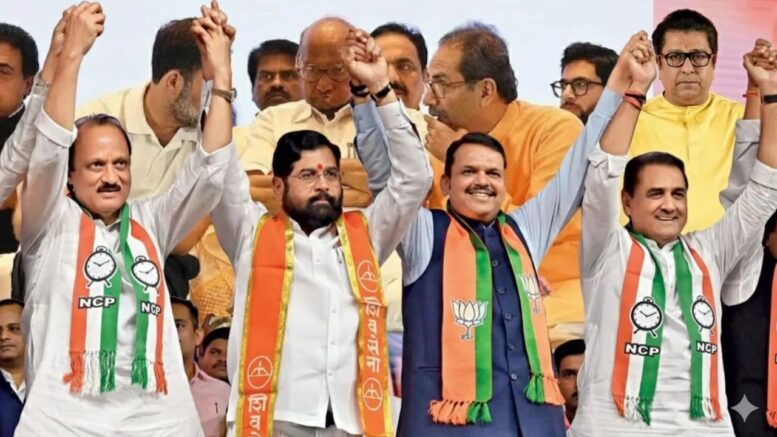
 Who Will Hoist The Triumph Flag In Mumbai: The Mahayuti’s triumphant march versus the Thackerays battle for Existence and Survival!
MUMBAI (RMN.IN):: The Brihanmumbai Municipal Corporation (BMC) is not just another civic body; it is Asia’s richest centre of power. The upcoming election is set to determine the future direction of Maharashtra’s politics. Officials of the State Election Commission (SEC) stated that nominations for the 227 seats in the 2026 BMC elections can be filed between December 23 and December 30. Scrutiny of nominations will take place on December 31. The last date for withdrawal is January 2, while the allotment of symbols and publication of the final list of candidates is scheduled for January 3.
The key aspects of this electoral battle are as follows:- BMC: An Ocean of Power
Massive budget: With an annual budget exceeding Rs.50,000 crore, the BMC is larger than many small Indian states.
Direct control: Control over basic services such as water, roads, healthcare, and education gives strong political leverage over the public.
Political nerve centre: Historically, whoever controls Mumbai wields significant influence over power in Maharashtra.
Mahayuti in ‘Mission Mode’ and High Confidence- Combined strength of three parties: The BJP’s organisational power, Eknath Shinde’s Shiv Sena, and Ajit Pawar’s NCP together have put the MahaYuti in an aggressive position.
Electoral momentum: Success in recent local elections has boosted MahaYuti’s confidence that “the wind is in their favour.”The Shinde factor: Many veteran corporators and local Shiv Sena leaders from the Thackeray camp joining the Shinde faction has enabled MahaYuti to make inroads into traditional voter bases.
A ‘Do or Die’ Situation for the Uddhav Thackeray Camp- Fight for survival: Losing power after ruling for nearly 25 years would threaten the very political identity of the Thackeray faction.
Symbol and identity: After the party split, winning this election is crucial for proving who represents the “real Shiv Sena.” Emotional appeal: The group is going all out to revive the magic of Marathi pride and the Thackeray name.
The Changing Mumbai Voter and Emerging Challenges-Voter confusion: Confusion among voters over the bow-and-arrow symbol and the original party could hurt the Thackeray camp.Need for new faces: With many experienced corporators having defected, finding energetic new candidates is a major challenge.Emotions alone aren’t enough: Today’s Mumbaikar is more focused on civic issues such as roads, potholes, traffic, and metro services.
Potential ‘Game Changer’ Issues-
Water and roads: Water scarcity and potholes will remain central election issues.Infrastructure: Credit battles over mega projects like the Coastal Road, Metro, and Dharavi redevelopment will intensify.Congress and Sharad Pawar faction: Though their overall strength is limited, their votes could be decisive in certain wards.
Mumbai’s political arithmetic varies by region—some areas vote on Marathi identity, others on development and business.
Dadar, Mahim, and Parel (The Heart of Shiv Sena)-Importance: Traditionally considered the impregnable stronghold of the undivided Shiv Sena; Sena Bhavan is located here, making this a prestige battle.Thackeray camp: Hardcore Shiv Sainiks here still feel emotionally connected to “Matoshree.” Local resentment against Sada Sarvankar (Shinde faction) could benefit the Thackeray camp.MahaYuti (Shinde faction/MNS): The influence of Sada Sarvankar and the MNS could lead to vote division, which MahaYuti will try to exploit.This contest is expected to be one of emotion versus resources.
Worli (Aditya Thackeray’s Stronghold)-
Importance: A high-profile battle as it is Aditya Thackeray’s constituency, with a mix of Koliwada, BDD Chawls, and elite residential areas.Thackeray camp: The Koli community and middle-class Marathi voters form their core support.
MahaYuti (BJP/Shinde faction): BJP has launched an aggressive campaign here. If the MNS fields a candidate, division of Marathi votes could pose a serious threat to the Thackerays. Hence, MahaYuti will deploy its full strength to corner Aditya Thackeray.Ghatkopar, Mulund, and Borivali (BJP Bastions)-
Importance: These areas have a large Gujarati, Marwari, and trading community population and are considered BJP’s core voter base.
MahaYuti (BJP): BJP enjoys near one-sided dominance here, with limited space for the Shinde or Ajit Pawar factions.Thackeray camp/Congress: The opposition’s presence is minimal. MahaYuti is likely to win the maximum number of corporators from these wards, making them ‘safe zones.’Bandra East, Kurla, and Chembur (Mixed Population)-
Importance: Bandra East houses Matoshree, making it extremely sensitive for the Thackerays. In Kurla and Chembur, Dalit and Muslim votes are decisive.Thackeray camp: Winning Bandra East is a matter of prestige due to Matoshree’s presence.MahaYuti (Shinde/Ajit Pawar factions): The influence of the late Baba Siddique and Zeeshan Siddique on Muslim votes will be crucial. Additionally, the alliance with the RPI (Athawale faction) could help BJP gain Dalit support.Andheri and Goregaon (Marathi + North Indian Factor)-Importance: Key western suburban belts with large Marathi working-class and North Indian voter populations.MahaYuti (BJP/Shinde faction): BJP has strengthened its grip on North Indian voters through Chhath Puja and other community events, while Shinde faction MLAs are active locally.
Thackeray camp: Their strength lies in local Marathi networks and shakha pramukhs.This region is where the Thackerays may feel the maximum impact of the Shinde faction’s rebellion.South Mumbai (Colaba to Byculla)-Importance: Old Mumbai, business hubs, and Muslim-majority areas.Congress/Thackeray camp: Muslim voters and traditional Congress supporters may back the alliance. BJP leader Rahul Narwekar holds influence in Colaba.MahaYuti: BJP will attempt to attract the business community using redevelopment and metro projects.

This election is not just about deciding Mumbai’s mayor—it will answer two major questions for Maharashtra: “Who is the real Shiv Sena?” and “Who truly controls Mumbai?” For the MahaYuti, this is a historic opportunity for victory; for the Thackeray camp, it may be the last chance to defend its bastion.